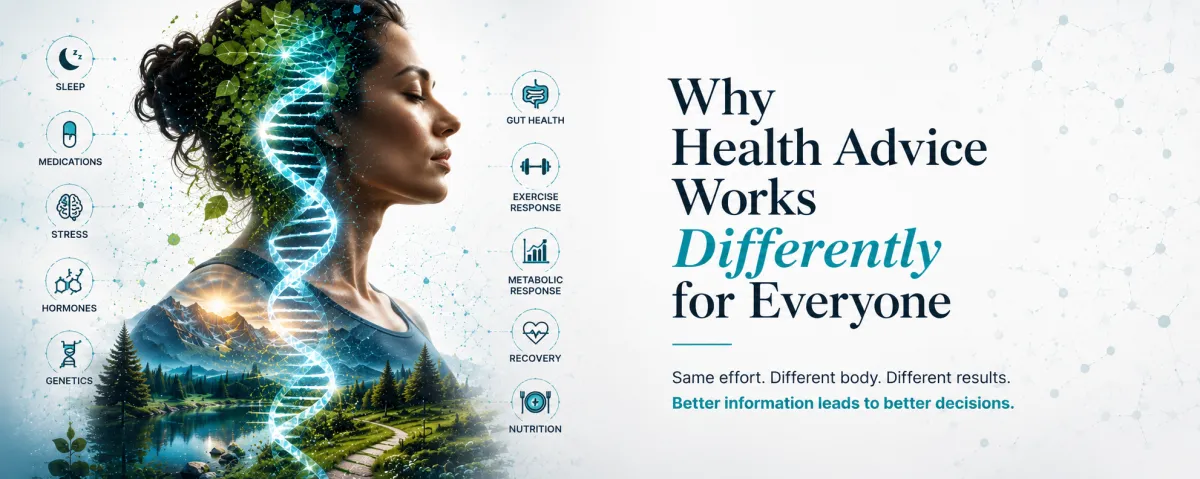
Why Health Advice Works Differently for Everyone
You've done the work. Cut the carbs. Hit the gym three days a week. Tracked your calories for six weeks straight.
Nothing changed.
So you assume you did something wrong. Maybe you weren't consistent enough. Maybe you need a stricter plan.
But what if the plan was never built for your body in the first place?
Generic Advice Is Built on Averages
Most nutrition and fitness recommendations work for populations. They don't always work for individuals.
A study of 800 people, published in the journal Cell, found that blood sugar responses to identical meals differed by as much as threefold between participants. Same food. Same portion. Completely different outcomes.
A 2023 study in Nature Communications confirmed it: your gut microbiome changes how much energy your body actually extracts from food. Two people eating the same thing, in the same environment, processed it differently at a measurable level.
The exercise research says the same thing. A twin study showed that even among people who share DNA, one twin responded to strength training while the other responded better to cardio.
This isn't opinion. It's been measured.
The Variables You're Not Looking At
You're tracking calories and workouts. But you're probably not tracking the things that determine whether those inputs produce results.
Sleep. Poor sleep changes insulin sensitivity within days. A good nutrition plan on five hours of broken sleep doesn't work the way it should.
Medications. Beta-blockers, some antidepressants, corticosteroids. They change how your body responds to food and exercise. You can't out-train them. They're context your plan needs to account for.
Stress. Chronic stress raises cortisol, which impacts fat storage, blood sugar regulation, and recovery. You can't supplement your way past a nervous system running hot all day.
Hormones. Thyroid, testosterone, estrogen, insulin. They all shift over time, especially after 40. The plan that worked five years ago might not work now because the internal environment changed.
None of this is about excuses. It's information.
Ask a Better Question
"Eat less, move more" isn't wrong. It's incomplete.
If you've been consistent and aren't seeing results, the answer probably isn't "try harder." A better question than "what am I doing wrong?" is "what information might be missing?"
Instead of cutting more calories, ask: is my sleep affecting my insulin response? Instead of adding more cardio, ask: is my recovery supporting this volume? Instead of blaming willpower, ask: are my medications or hormones creating a headwind I haven't addressed?
Better information leads to better decisions.
If you've been doing the work and not seeing results, the problem probably isn't effort. It might be that nobody's looked at the full picture yet.
Take the Performance & Wellness Profile. It takes about 10 minutes and helps identify which variables might be working against you, so we can figure out what to do about it.
References
Zeevi, D., et al. (2015). Personalized Nutrition by Prediction of Glycemic Responses. Cell, 163(5), 1079-1094. PMID: 26590418 — https://pubmed.ncbi.nlm.nih.gov/26590418/
Leshem, A., Segal, E., & Elinav, E. (2020). The Gut Microbiome and Individual-Specific Responses to Diet. mSystems, 5(5). PMID: 32994289 — https://pubmed.ncbi.nlm.nih.gov/32994289/
Corbin, K.D., et al. (2023). Host-diet-gut microbiome interactions influence human energy balance: a randomized clinical trial. Nature Communications, 14, 3161. PMID: 37258525 — https://pubmed.ncbi.nlm.nih.gov/37258525/
Renwick, J.R.M., et al. (2024). Standard Deviation of Individual Response for VO2max Following Exercise Interventions: A Systematic Review and Meta-analysis. Sports Medicine. PMID: 39160296 — https://pubmed.ncbi.nlm.nih.gov/39160296/
Marsh, C.E., et al. (2020). Fitness and strength responses to distinct exercise modes in twins: Studies of Twin Responses to Understand Exercise as a THerapy (STRUETH). Journal of Physiology, 598(18), 3845-3858. PMID: 32567679 — https://pubmed.ncbi.nlm.nih.gov/32567679/
