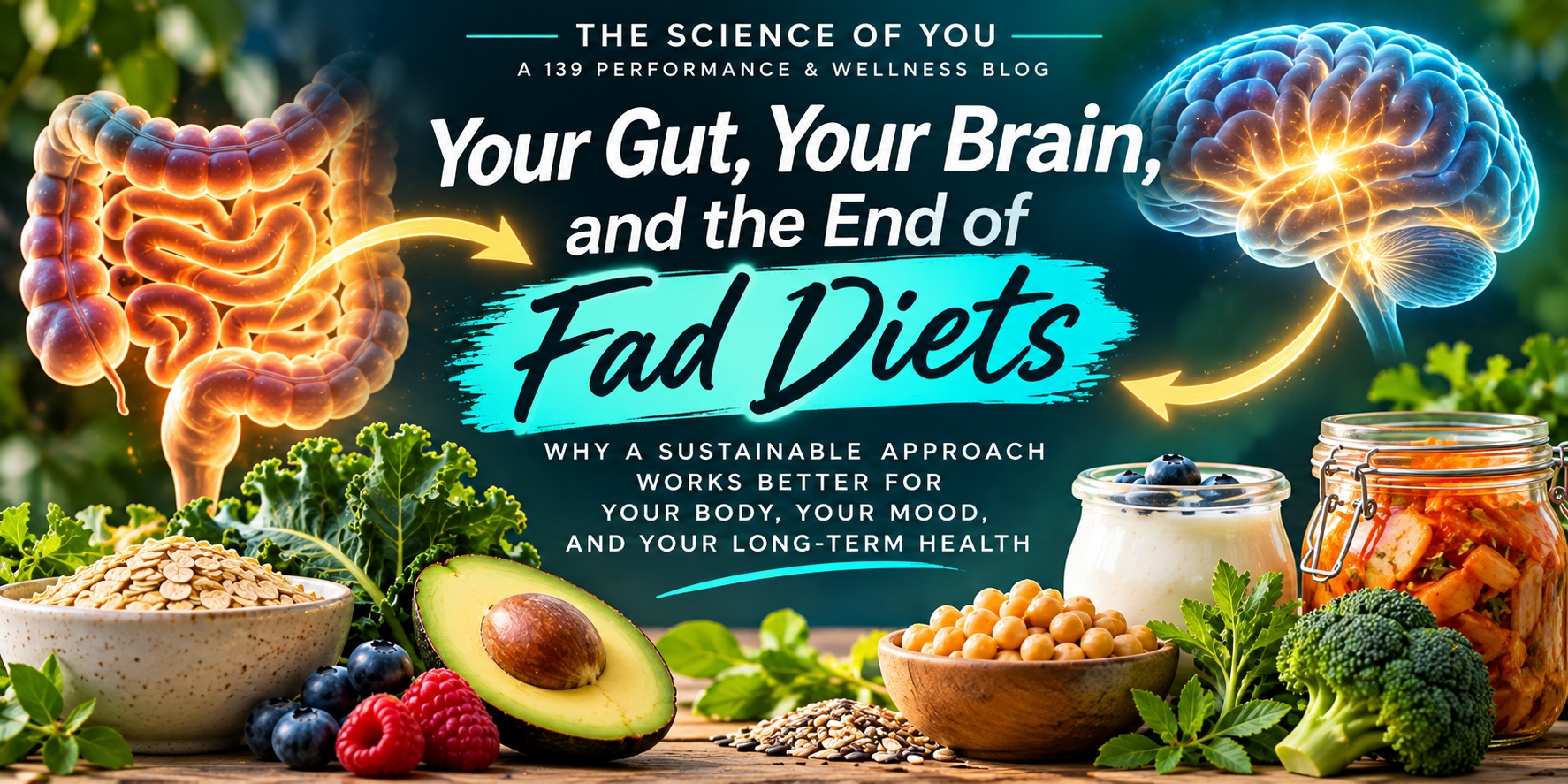
Your Gut, Your Brain, and the End of Fad Diets,
Week 7 Blog (Serial Dieters) — Your Gut, Your Brain, and the End of Fad Diets
Oct 5, 2026
If you've tried every diet, this one's for you
Keto. Juice cleanses. Intermittent fasting. The one with the points, and the one where you couldn't eat after 6 p.m.
If you've cycled through more plans than you can count, here's something worth hearing: it was never a willpower problem. Each plan asked your body to adapt to a new set of rules, then threw them out a few weeks later. One part of your body has been quietly keeping score the whole time. It's your gut, and it talks to your brain more than most people realize.
Your gut and brain are in constant conversation
Scientists call it the gut-brain axis: a two-way communication network between your digestive system and your brain (1). Trillions of microbes in your gut help run that conversation. They break down the food you eat and make compounds that affect digestion, inflammation, and how your body handles stress.
In plain terms, what you eat shapes your gut. Your gut helps shape how you feel. And how you feel shapes what you eat next.
What the research is telling us
Recent reviews of the science land in the same place: diet is one of the most powerful, changeable influences on your gut bacteria, and that has real effects on the gut-brain connection (2). A few findings stand out for anyone tired of the diet merry-go-round:
Your gut remembers past diets.In a study in mice, gut bacteria stayed changed long after the animals lost weight. When they went back to their old eating pattern, that leftover "microbiome memory" helped them regain weight faster (3). It's animal research, but it offers one explanation for why yo-yo dieting can feel like it gets harder each round.
Steady beats extreme.In a 4-week trial, adults who ate more fiber-rich produce, beans, whole grains, and fermented foods reported a 32% drop in perceived stress. The group given standard healthy-eating advice dropped 17%. People who followed the plan more closely saw bigger improvements (4).
Fermented foods help diversity.Healthy adults who added fermented foods for 10 weeks grew a more diverse gut microbiome and lowered several markers of inflammation (5).
Food quality connects to mood.In a 12-week trial, adults with depression who worked with a dietitian to improve their overall eating pattern saw greater symptom improvement than those who received social support alone (6).
These studies don't prove that one specific food fixes your mood or your weight. Researchers still say longer studies are needed (2). But the direction is consistent: a varied, plant-rich, sustainable way of eating supports your gut far better than constant restriction.
What to do instead of the next fad
You don't need a new set of rules. You need a few habits your gut can count on:
Add before you subtract.Focus on including more vegetables, fruit, beans, oats, nuts, and seeds rather than cutting out whole food groups.
Go slowly with fiber.Increase it gradually so your gut has time to adjust.
Try a small daily fermented food.Plain yogurt, kefir, sauerkraut, or kimchi are easy starting points.
Protect your sleep and manage stress.Both affect digestion as much as what's on your plate.
Notice how you feel.Energy, mood, digestion, and cravings are useful information, not failures.
If you have ongoing digestive symptoms or struggle with your mood, check in with a healthcare professional. Food supports your health, but it doesn't replace proper care.
You don't have to figure this out alone
After years of following someone else's rules, it can feel strange to start listening to your own body. That's exactly where I come in. Together, we'll look at your history, your habits, and how your body actually responds, then build a plan you can live with long after the next trend fades.
Ready to step off the diet merry-go-round?Take the free Performance & Wellness Profileand let's start with you.
References
Cryan JF, O'Riordan KJ, Cowan CSM, et al. The microbiota-gut-brain axis.Physiol Rev.2019;99(4):1877-2013.PMID: 31460832
Almahal ZH, et al. Molecular perspective of dietary influences on the gut microbiome alongside neurological health: exploring the gut-brain axis.ACS Chem Neurosci.2025;16(11):1996-2012.PMID: 40323127
Thaiss CA, Itav S, Rothschild D, et al. Persistent microbiome alterations modulate the rate of post-dieting weight regain.Nature.2016;540(7634):544-551.PMID: 27906159
Berding K, Bastiaanssen TFS, Moloney GM, et al. Feed your microbes to deal with stress: a psychobiotic diet impacts microbial stability and perceived stress in a healthy adult population.Mol Psychiatry.2023;28(2):601-610.PMID: 36289300
Wastyk HC, Fragiadakis GK, Perelman D, et al. Gut-microbiota-targeted diets modulate human immune status.Cell.2021;184(16):4137-4153.e14.PMID: 34256014
Jacka FN, O'Neil A, Opie R, et al. A randomised controlled trial of dietary improvement for adults with major depression (the 'SMILES' trial).BMC Med.2017;15:23.PMID: 28137247
