Protein: How much do you need
How Much Protein Do You Actually Need?
Coffee. Toast. Maybe some yogurt. You've been trying to eat better, so the question shows up before the caffeine even hits:how much protein do I actually need?
Google gives you fifty answers. Someone says 100 grams. Someone else says a gram per pound. You're doing math before breakfast is even finished.
Here's the truth nobody leads with:there is no single number that works for everyone.The right amount depends on your age, your activity level, your goal, and how you spread it across the day. A number borrowed from someone else's plan fits their life — not yours.
The RDA Is a Floor, Not a Target
The Recommended Dietary Allowance for protein is 0.8 grams per kilogram of body weight per day. Research is clear about what that number actually means: it was set to prevent deficiency in nearly all healthy adults — not to optimize performance, recovery, or body composition (PMID: 28298271).
A floor keeps you from falling. It doesn't tell you where you should be standing.
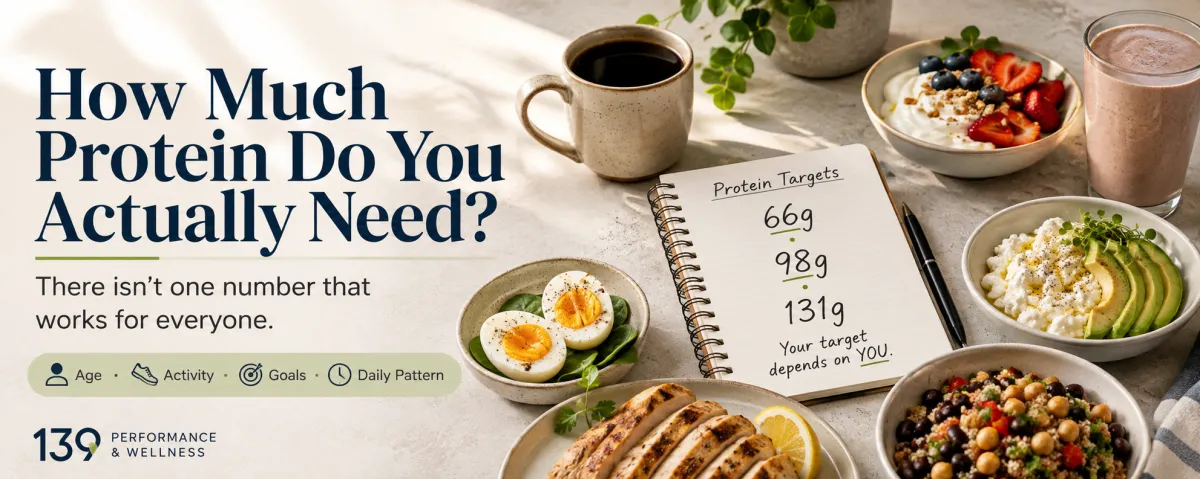
Take a 180-pound person — about 82 kilograms. The RDA works out to roughly 66 grams a day. That covers the baseline. But if you're active, working to lose fat, or trying to hold onto muscle, 66 grams probably isn't doing the job.
Your Number Isn't a Universal Number
Protein needs shift with you — they're not fixed. A sedentary 35-year-old, an active 55-year-old, and someone in a calorie deficit are working with different physiology and different demands.
Research on aging adults recommends at least 1.0 - 1.2 grams per kilogram per day for adults over 65, with more needed during illness or increased activity (PMID: 23867520). That's not a universal number for every older adult — it's a signal that age belongs in the conversation.
Broader research on protein needs across aging, exercise, and calorie restriction reaches the same conclusion: quantity, quality, and distribution all matter, and the right target depends on the problem you're actually solving (PMID: 26960445).
If you're managing kidney disease or another condition that changes how your body processes protein, this is a conversation to have with your provider before you adjust anything. Personalized doesn't mean guessing — it means working from better information.
Fix the Daily Total First
Before you think about powders, timing, or which supplement has the best marketing, look at your total protein intake across the day. If that number is consistently low, nothing you stack on top of it will fix it.
Back to our 180-pound example: a range of 1.2–1.6 grams per kilogram lands around 98–131 grams a day. Not a prescription — an illustration of how the target shifts once age, activity, and goals enter the picture.
You don't need to hit an exact number every day. You need a pattern you can repeat. Build each meal around a real protein source, then adjust based on your body, your training load, and your total calorie needs.
And protein isn't the whole meal — it's the anchor. Vegetables, fruit, fiber, healthy fats, and adequate total energy still matter. A high-protein plan that crowds out everything else isn't automatically a better one.
Distribution Matters More Than Most People Think
Here's a pattern I see constantly: 8 grams at breakfast, 15 at lunch, 60 at dinner. The daily total looks fine on paper — but that person is running on empty until 7pm and asking one meal to make up for the whole day.
A controlled study found that spreading protein evenly across three meals produced a 25% greater muscle protein synthesis response over 24 hours compared to loading most of it at dinner (PMID: 24477298).
That doesn't mean every meal needs to be identical — it means the pattern attention. Separate research on post-exercise protein dosing found that roughly 20 grams of high-quality protein maximized the muscle protein synthesis response measured in young men in that study — useful context, not a rule for every meal or every person (PMID: 19056590).
The practical move: give every main meal a real protein source.
Breakfast— eggs, Greek yogurt, cottage cheese
Lunch— chicken, fish, beans, lentils, tofu
Dinner— same idea, portioned to your needs
The goal isn't perfect distribution. It's to stop asking dinner to rescue a low-protein day.
Make It Work When Life Is Busy
The best protein target is the one you can actually hit on a Tuesday when your schedule falls apart.
Rushed mornings→ keep 2–3 go-to options ready: Greek yogurt and fruit, eggs made ahead, a smoothie for the days sitting down isn't realistic.
Chaotic lunches→ make protein visible. Beans in the grain bowl. Tuna or tofu on the salad. Last night's leftovers instead of a separate project.
Dinner→ protein, vegetables, a carb source that fits your needs, fat for flavor. It doesn't need to be complicated.
If you use a protein supplement, treat it as a tool that fills a gap — not a replacement for a varied way of eating.
More Isn't Automatically Better
Protein talk online tends to turn into a competition. Bigger numbers sound more disciplined. But once your intake is adequate for your context, pushing it higher isn't guaranteed to get you more.
You still need enough total energy. You still need fiber, micronutrients, and a plan that survives past Thursday. A strength athlete, a sedentary adult, an older adult, and someone in a deficit may all need different targets — and even within those groups, food preferences, health history, and schedule shape what actually works.
There's no prize for turning every meal into a math problem. The right target is the one that supports your goal and fits your life.
Ask a Better Question
Instead of chasing the perfect number, ask questions that connect the science to your actual life:
How active am I right now?
Am I trying to maintain, build, or lose?
Am I getting real protein at breakfast and lunch — or saving it all for dinner?
Am I older, recovering, or in a situation where the baseline might not be enough?
Do I actually know what I'm eating, or am I reacting to a number I saw on someone else's plan?
Those questions lead somewhere useful because they start withyou— not a generic target. That's the whole point of personalized nutrition. Not more rules. A better fit.
The Bottom Line
You don't need a magic number. You need a target that fits your age, your activity, your goal, and the way you actually eat across the day.
Start with the total. Then look at the distribution. Make one meal better before you try to redesign everything.
The answer was never "more protein." It'senoughprotein, in a pattern you can repeat, for a reason that actually matches what you're trying to do.
Look at one meal today and ask yourself: does this meal support the goal I keep saying I have?
Better information leads to better decisions.
Take the Performance & Wellness Profile →and find out where your plan has room to improve.
References
Wolfe RR, Cifelli AM, Kostas G, Kim IY. Optimizing Protein Intake in Adults: Interpretation and Application of the Recommended Dietary Allowance Compared with the Acceptable Macronutrient Distribution Range.Advances in Nutrition.2017;8(2):266-275. PMID: 28298271.
Bauer J, Biolo G, Cederholm T, et al. Evidence-Based Recommendations for Optimal Dietary Protein Intake in Older People: A Position Paper From the PROT-AGE Study Group.Journal of the American Medical Directors Association.2013;14(8):542-559. PMID: 23867520.
Phillips SM, Chevalier S, Leidy HJ. Protein "Requirements" Beyond the RDA: Implications for Optimizing Health.Applied Physiology, Nutrition, and Metabolism.2016;41(5):565-572. PMID: 26960445.
Mamerow MM, Mettler JA, English KL, et al. Dietary Protein Distribution Positively Influences 24-h Muscle Protein Synthesis in Healthy Adults.The Journal of Nutrition.2014;144(6):876-880. PMID: 24477298.
Moore DR, Robinson MJ, Fry JL, et al. Ingested Protein Dose Response of Muscle and Albumin Protein Synthesis after Resistance Exercise in Young Men.The American Journal of Clinical Nutrition.2009;89(1):161-168. PMID: 19056590.
