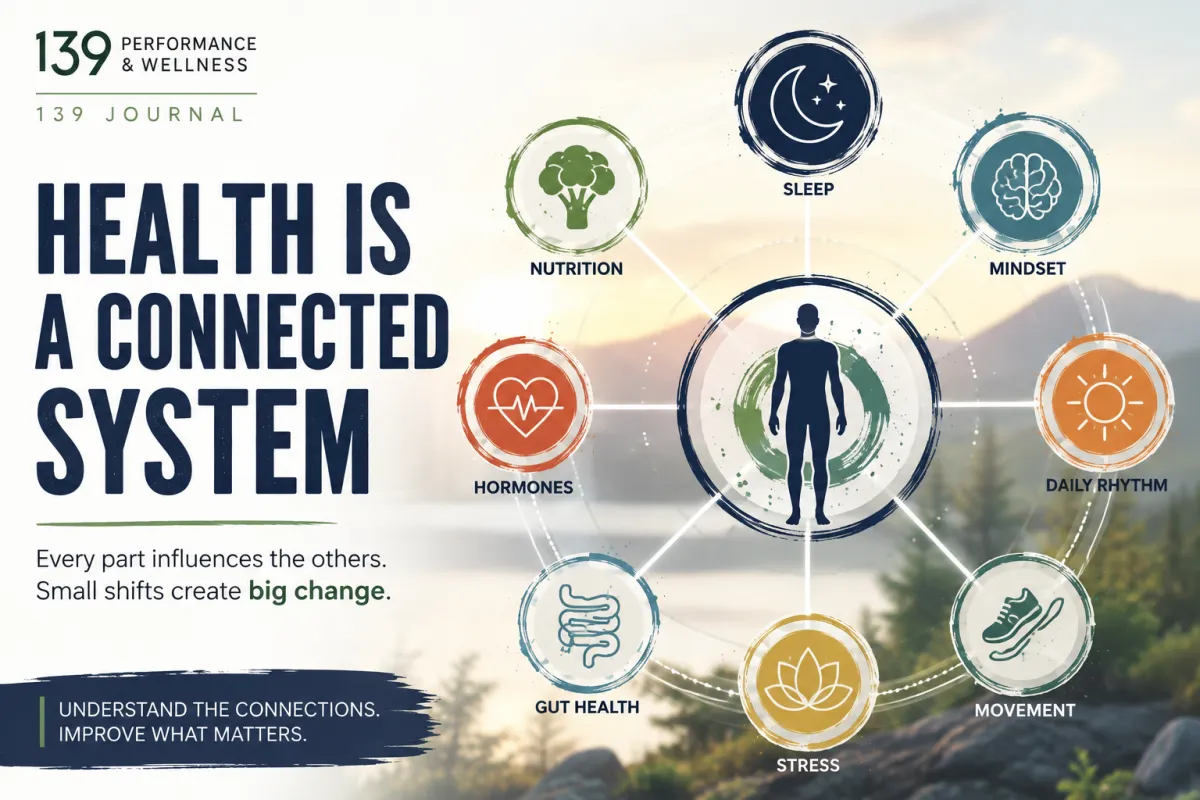
Health Is a Connected System
Health Is a Connected System
139 Journal • 139 Performance & Wellness
Evidence-informed perspectives on health, performance, and longevity.
You clean up your food. You walk more. You buy the supplement. You go to bed earlier. Yet somehow, you still feel stuck.Your energy is off. Hunger feels louder than it should. Digestion is unpredictable. Your workouts do not feel the way they used to. The natural response is to look for a stronger fix—a stricter plan, different macros, another supplement, more discipline.
But sometimes the problem isn't that you aren't doing enough. It's that your body isn't a collection of separate parts. It's a connected system.
Sleep affects hunger. Stress affects digestion. Physical activity affects sleep and recovery. Your gut communicates with your brain. Meal timing influences energy and metabolism. When one part changes, others often change with it. That means focusing on one symptom—or one solution—can cause you to miss the larger pattern.
The One-Variable Trap
Most health advice focuses on isolated variables: eat more protein, cut sugar, lift weights, sleep eight hours, drink more water. None of those are necessarily bad recommendations. The problem comes when we treat them like independent switches: flip the right one and everything improves.
You might improve your nutrition while poor sleep continues to disrupt appetite and recovery. You might train harder while high stress makes recovery increasingly difficult. You might eat nutritious foods but have inconsistent meals, little sleep, and high daily stress.
The individual choices may be good. The overall environment may still be working against you.
Sleep Changes More Than Energy
Poor sleep doesn't simply make you tired. It can influence hunger, food choices, exercise, recovery, and stress regulation.That means a nutrition plan that looks great on paper can become much harder to follow when sleep is consistently poor. Research examining nutrition, physical activity, and sleep reinforces the importance of looking at these behaviors together rather than completely independently (PMID: 35565879). When someone says, “I know what to do. I just can't seem to do it consistently,” willpower may not be the first place to look. Sleep might be.
Stress Doesn't Stay in One Lane
Stress isn't only psychological. It can influence sleep, appetite, digestion, recovery, inflammation, and metabolic health. The concept of allostatic load describes the cumulative burden placed on the body as multiple systems repeatedly adapt to stress. Research has associated common health-risk behaviors with greater allostatic load, reinforcing the importance of looking at the total pattern rather than one behavior in isolation (PMID: 31846655).Sometimes the answer isn't another nutrition intervention. It may be reducing the overall load your body is trying to manage.
Your Gut and Brain Communicate
Digestive health and mental health aren't completely separate systems either. Communication between the gut and brain runs in both directions. Stress can influence gut function, while diet and the microbiome can influence signaling back to the brain. Research into the microbiome-gut-brain axis demonstrates how interconnected these systems are (PMID: 29276734). Exercise may influence this relationship as well, providing another example of how movement affects much more than calories burned (PMID: 30704343).
One input can have several consequences.
Timing Is Part of the Picture
Your body also responds to when things happen. Food, sleep, movement, and light exposure provide signals that interact with circadian rhythms, hormones, metabolism, and energy. Research examining meal timing and circadian biology highlights this relationship between timing, hormonal signaling, and metabolism (PMID: 37754352). This doesn't mean your schedule needs to be perfect. It means patterns matter.
Zoom Out Before You Change the Plan
If health is a connected system, guessing at isolated solutions becomes a weak strategy. Instead of only asking, “What should I take?” or “What should I stop eating?” ask better questions:
·What changed before this problem started?
·How has my sleep been?
·What happens to my energy when meals become inconsistent?
·Does my digestion change during stressful periods?
·Am I giving my body enough opportunity to recover?
This is part of the reasoning behind personalized nutrition and systems-based approaches to health: biological responses occur through interconnected networks rather than isolated pathways (PMID: 28969366). Two people can follow similar advice and experience very different outcomes because their context is different: sleep, stress, medications, health history, activity levels, and physiology.
Try This for One Week
For the next seven days, simply track five things:
1.Sleep quality
2.Meal timing
3.Energy
4.Stress
5.Digestion
Don't try to fix everything yet. Look for connections. Maybe cravings are strongest after poor sleep. Maybe digestion changes during stressful days. Maybe workouts feel better when meals are more consistent. Maybe the afternoon crash follows both a short night and a skipped lunch.
Those patterns are information. And information gives you somewhere useful to start.
The Bigger Picture
Health rarely comes down to one food, one supplement, one workout, or one habit.
It's a connected system.
When you stop looking at each symptom in isolation and start looking for connections, you gain a clearer picture of what may actually need attention. Sometimes progress doesn't begin with doing more. It begins with seeing the whole picture.
Research References
·PMID: 35565879 — Nutrition, physical activity, and sleep-related research.
·PMID: 31846655 — Health-risk behaviors and allostatic load.
·PMID: 29276734 — Microbiome-gut-brain axis and stress.
·PMID: 30704343 — Exercise and the microbiome-gut-brain axis.
·PMID: 37754352 — Meal timing, circadian rhythms, hormones, and metabolism.
·PMID: 28969366 — Systems biology approaches to personalized nutrition.
