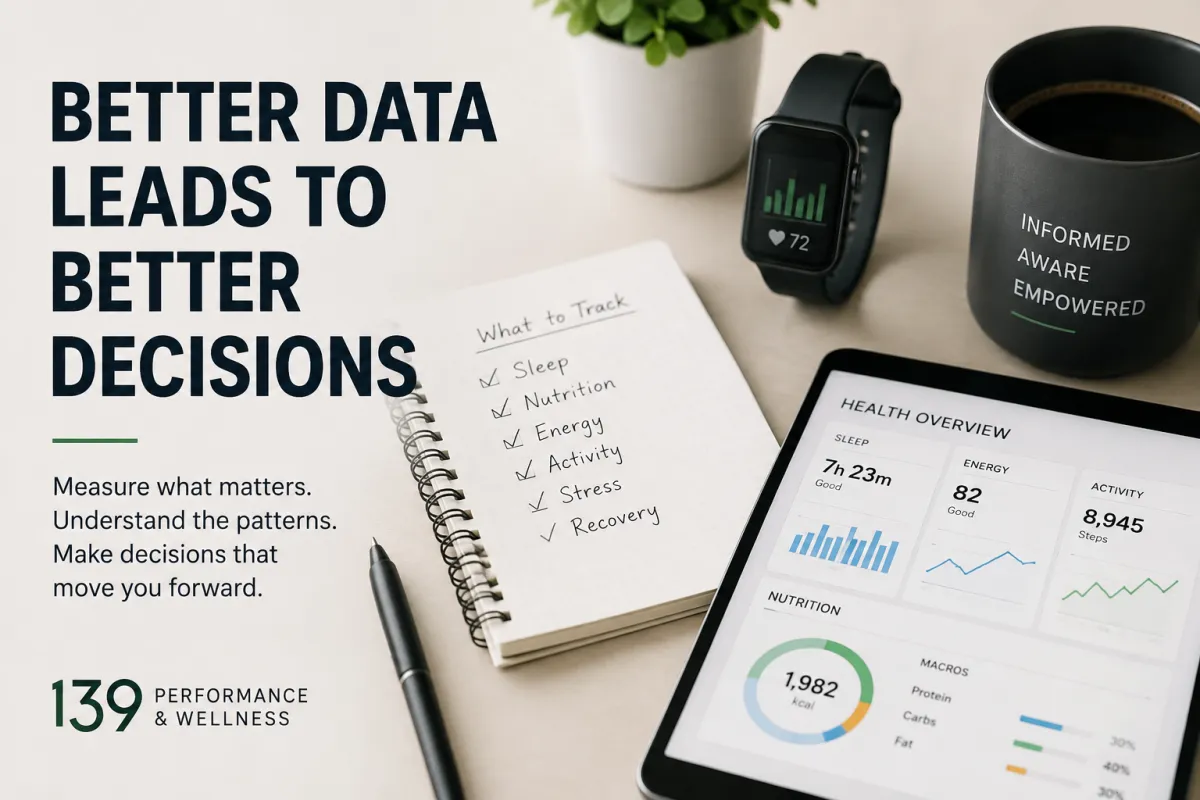
Better Data Leads to Better Decisions
Better Data Leads to Better Decisions
139 Journal • 139 Performance & Wellness
Evidence-informed perspectives on health, performance, and longevity.
How many of your health decisions are based on something you actually measured—and how many are based on an assumption? Most of us make at least some decisions by feel. We eat what seems healthy, exercise when we can, cut calories when the scale rises, and change the plan when progress stalls.
When that doesn't work, it's easy to assume the answer is more discipline.
But sometimes the missing piece isn't effort. It's information.
Better data doesn't mean tracking everything. It means gathering information that helps you make a better decision.
Effort Needs Direction
Trying harder can only take you so far if you don't know what needs to change. Self-monitoring research gives us a useful example. A 2021 systematic review of 39 studies found that greater engagement with digital self-monitoring was associated with weight loss in most of the reported comparisons (PMID: 33624440). A separate 2021 meta-analysis of 12 randomized trials found that digital monitoring of diet and physical activity supported weight loss, with tailored interventions performing better than non-tailored approaches (PMID: 34192411).
The takeaway isn't that everyone needs another app. It's that useful feedback can turn effort into informed action.
What Better Data Actually Means
Better data can be simple.
It might mean noticing when your energy drops, tracking sleep for two weeks, recording when meals happen, watching how training affects recovery, or comparing what you think you're doing with what is happening. For some questions, clinical information may also matter. Biomarkers and health history can provide context that habits alone cannot. The goal isn't to collect the most data. It's to collect the data that helps answer the question in front of you.
Personalization Needs Evidence, Not Hype
Personalized nutrition is promising, but the research is more nuanced than saying personalized advice always wins.
A 2022 systematic review of randomized trials found that personalized nutrition interventions did not consistently outperform standard approaches across behavioral and health outcomes (PMID: 36235756). That uncertainty matters. At the same time, a 2024 randomized trial involving 347 adults found that an 18-week personalized dietary program using health history, microbiome information, and individual post-meal responses improved some cardiometabolic outcomes compared with general dietary guidance (PMID: 38714898).
The responsible conclusion is not that more personalization is automatically better. It's that individual data can be useful when it is relevant, interpretable, and connected to a specific decision.
Data Adds Context to How You Feel
How you feel matters. But feelings and memory can miss patterns.
“I eat pretty well.” “I sleep enough.” “Nothing is changing.” Those statements may be completely sincere, but they don't always tell us what is happening over time.
Tracking can reveal patterns that are difficult to see day to day. It can also show when something is improving even if progress feels slow. Data shouldn't replace your experience. It should give your experience more context.
Three Levels of Useful Information
Level 1: Awareness. Pay attention to patterns you normally overlook: energy, hunger, meal timing, sleep, stress, digestion, and recovery.
Level 2: Intentional Tracking. Choose one or two relevant measures and follow them long enough to see a pattern. Track to answer a question—not simply to accumulate numbers.
Level 3: Clinical Data. When appropriate, laboratory testing and other objective measures can add information that lifestyle tracking cannot provide. The value comes from choosing the right test for the right question and interpreting it in context.
Shift From Judgment to Curiosity
One of the most useful mindset shifts is moving from:
“What am I doing wrong?”
to:
“What information might I be missing?”
The first question looks for blame. The second looks for something you can learn. That doesn't make health simple. It makes your next decision more informed.
Try This for Two Weeks
Choose one question you want to answer, then track only the information that could help answer it.
·If afternoon energy is the problem: note sleep, meal timing, and what you ate before the crash.
·If hunger feels unpredictable: note meal composition, timing, sleep, and stress.
·If training feels worse: note sleep, recovery, food intake, and training load.
Don't track everything. Track with a purpose.
The Bigger Picture
Better health decisions don't come from having the most information. They come from having the right information and knowing what to do with it. Sometimes that information comes from awareness. Sometimes from tracking. Sometimes from clinical data. The goal is the same: replace assumptions with useful information.
Because when the information gets better, the next decision can get better too.
Research References
·Patel ML, Wakayama LN, Bennett GG. Self-Monitoring via Digital Health in Weight Loss Interventions: A Systematic Review Among Adults with Overweight or Obesity. Obesity. 2021. PMID: 33624440.
·Berry R, Kassavou A, Sutton S. Does self-monitoring diet and physical activity behaviors using digital technology support adults with obesity or overweight to lose weight? Obesity Reviews. 2021. PMID: 34192411.
·Shyam S, et al. Effect of Personalized Nutrition on Dietary, Physical Activity, and Health Outcomes: A Systematic Review of Randomized Trials. Nutrients. 2022. PMID: 36235756.
·Effects of a personalized nutrition program on cardiometabolic health: a randomized controlled trial. 2024. PMID: 38714898.
